

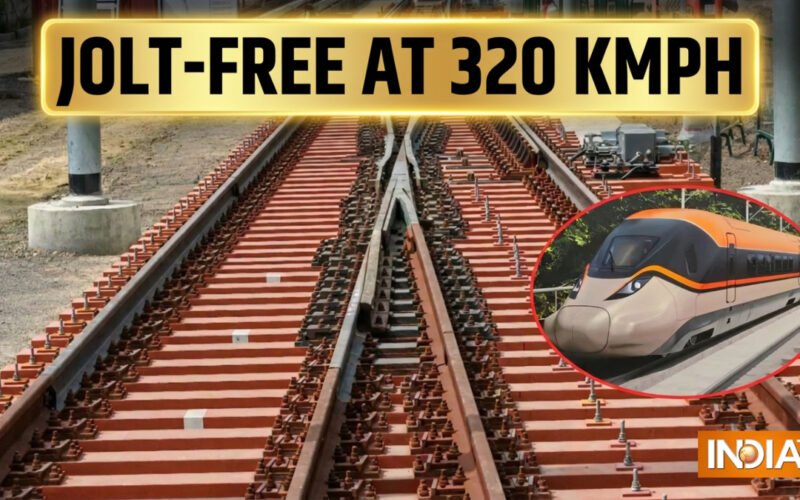
India’s much-awaited bullet train will feature several first-of-their-kind features. As the construction progresses on the 508-kilometre Mumbai-Ahmedabad High-Speed Rail Corridor, some interesting details are now emerging. Latest updates suggest the bullet train will use state-of-the-art technology to ensure passengers don’t feel jolts even when changing tracks at 320 kmph. This technology will provide the train’s wheels with a consistent and smooth surface even when changing tracks.
Why will a bullet train be jolt-free while changing tracks?
A typical railway track has a small gap where two rail lines intersect. When train wheels pass through this area, passengers can feel jolts and vibrations. However, for a train travelling at speeds of up to 320 km per hour, such a gap can pose a significant challenge. To address this problem, modern technologies such as movable crossings, also known as swing-nose crossings, and canted turnouts are being used on the Mumbai-Ahmedabad High-Speed Rail Corridor. This is the first time the Indian Railways will use this technology on its network.
How will the movable crossing work?
Normal tracks have a gap between the rails at the crossing. To eliminate this gap in high-speed rail, a point machine adjusts the nose of the rail. This creates a continuous rail surface at the crossing. This means that the train wheels move on a continuous surface instead of hitting an open gap. This helps reduce jolts, vibrations, and track stress at high speeds.
Canted turnouts will reduce side shock
Another important technology is canted turnouts. Turnouts are systems that allow trains to transition from one track to another. The tracks are tilted in a specific way, with the outer rails higher than the inner rails. This helps balance the side forces generated when trains change tracks. As a result, passengers inside the train experience less sudden sideways pulls or sharp vibrations, making for a more stable ride.
Digital monitoring system
To ensure safety, this high-speed track system will use modern point machines, interlocking systems, and automatic train identification systems. These systems will help ensure that tracks and crossings are in good condition before trains pass through.
The Mumbai-Ahmedabad High-Speed Rail Corridor is approximately 508 kilometres long. It will connect Mumbai and Ahmedabad, with a design train speed of 320 kmph. The project is planned to have 12 stations. Mumbai will also have approximately 21 kilometres of underground sections, including India’s first undersea rail tunnel beneath Thane Creek.
ALSO READ:
When will India’s first bullet train start running? Ashwini Vaishnaw gives major update