

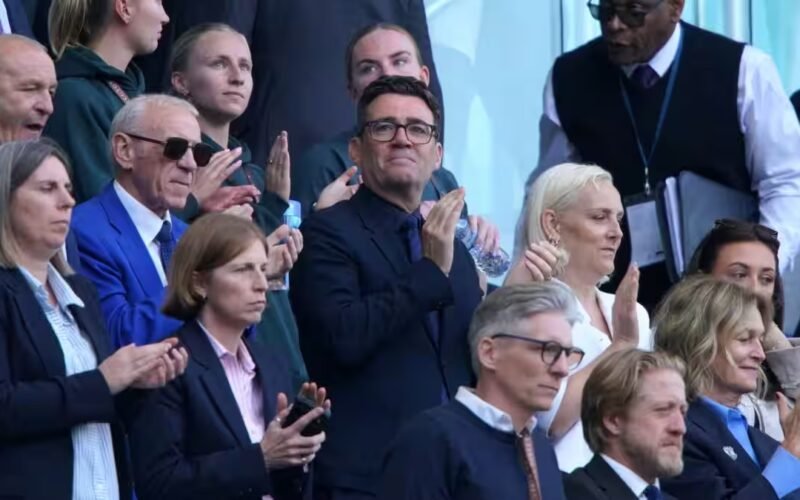
England could be heading for a major change in football stadium rules as UK Prime Minister Andy Burnham backs a review of the 41-year ban on drinking alcohol within sight of the pitch. Supporters and clubs favour reform, while police warn it could increase disorder and safety risks
United Kingdom Prime Minister Andy Burnham has signalled that the government is actively considering ending the 41-year ban on drinking alcohol within sight of the pitch at men’s football matches.
Speaking to reporters on the sidelines of the United Nations General Assembly in New York City, Burnham described the landmark prohibition as “outdated” and “discriminatory,” calling for pilot trials to test bringing football in line with virtually every other spectator sport and entertainment event in the country.
The remarks has brought back a long-simmering battle among supporter advocacy groups, football league executives and law enforcement agencies
At the core of the dispute is the Sporting Events (Control of Alcohol etc) Act 1985, a piece of emergency legislation enacted during the height of 1980s football hooliganism.
While fan organisations and commercial leaders have applauded the government’s willingness to modernise stadium regulations, police chiefs have pushed back aggressively, warning that relaxing restrictions could lead to a resurgence of matchday disorder.
What did UK PM Andy Burnham say?
Responding to questions regarding long-standing criticisms of the UK’s sports licensing laws, Burnham — a lifelong Everton supporter — stated that he does not believe it is fair for football spectators to be treated differently from fans of other sports.
“I don’t think it’s fair for football fans to be singled out in that way,” Burnham told reporters.
 More from Explainers
“That legislation dates to an era where football was very different, and I do believe there is a case to remove that discrimination. There are different ways it could be done, perhaps on a trial basis. But I’m not going to back away from what’s been a long-held view of mine. I don’t see how it can be fair that some supporters of one sport can be treated differently from others.”
The comments built upon visual observations he made earlier at Everton’s Hill Dickinson Stadium during a rugby league fixture.
Attending the event alongside Liverpool City Region Mayor Steve Rotheram, Burnham noted that rugby supporters sitting in the exact same stadium seats were legally permitted to enjoy a pint of beer while watching the match — a right strictly denied to football fans attending an Everton fixture in the very same stadium the following week.
The prime minister’s willingness to review the ban marks a substantial shift in government tone. Previous administrations held firm against altering the 1985 Act, maintaining that football posed a unique public order risk.
However, with growing pressure from lower-league clubs seeking revenue and fan organisations demanding equal treatment, the government appears ready to explore controlled pilot schemes.
What does the law say?
In the mid-1980s, English football was plagued by severe incidents of violence and stadium disorder. Tragic and violent events — including the Heysel Stadium disaster in May 1985 and major riots at matches such as Luton Town vs Millwall — led Margaret Thatcher’s government to introduce rapid legislative measures.
Parliament quickly passed the Sporting Events (Control of Alcohol etc) Act 1985 (SECAA) to curb alcohol-fuelled hooliganism.
The 1985 Act created several specific criminal offenses surrounding designated sporting events:
- Prohibition in sight of the pitch (Section 2): It is a criminal offence to consume alcohol, or possess an open container of alcohol, in any area of a stadium from which the event can be directly viewed. This restriction applies from 15 minutes before kick-off until 15 minutes after the final whistle.
- Alcohol on supporter transport (Section 1): It is an offence to carry alcohol, or be in possession of alcohol, on public service vehicles, coaches, or minibuses carrying passengers to or from a designated sporting event.
- Intoxication at turnstiles (Section 2): It is illegal to enter, or attempt to enter, a designated football stadium while drunk.
- Police search powers (Section 7): Police officers are granted powers to stop and search supporters, coaches, and trains suspected of carrying alcohol to designated matches.
The law specifically applies to the top five tiers of English men’s football: the Premier League, the Championship, League One, League Two, and the National League.
But the law does not ban alcohol from football stadiums entirely.
Drinking is permitted within enclosed concourses, executive boxes (provided curtains or blinds are drawn during match play so the pitch cannot be seen from the bar area), and stadium restaurants prior to kick-off and at half-time.
The 1985 Act only applies almost exclusively to men’s professional football. Sports such as rugby union, rugby league, cricket, darts, and horse racing operate under standard local authority premises licensing laws.
Spectators at Lord’s Cricket Ground, Twickenham Stadium, or the PDC World Darts Championship can routinely purchase alcoholic drinks and consume them in their seats.
What are the arguments for lifting the ban?
Advocates for legislative reform — including the Football Supporters’ Association (FSA), the English Football League (EFL), and hospitality industry representatives — arguing that a 40-year-old law no longer fits the reality of modern stadium design, fan demographics, or event management.
Ending the “binge drinking” effect
One of the primary arguments made by safety experts and fan advocacy groups is that the current restriction actually creates public order issues rather than preventing them.
Because supporters cannot drink in their seats during the match, many engage in “pre-loading” — consuming excessive amounts of high-proof alcohol in local pubs or outside grounds immediately before entering.
Once inside, the 15-minute half-time window causes thousands of fans to rush to the concourse bars simultaneously, downing multiple pints in minutes before returning to their seats.
Experts argue that permitting steady, controlled consumption in seats throughout the 90 minutes would smooth out drinking patterns, reduce concourse overcrowding, and lower overall levels of acute intoxication.
Structural parity across sports and events
Stadiums across the UK frequently host summer music concerts, boxing bouts, and non-football sporting events where fans freely consume alcohol in the stands without widespread disorder.
Supporters argue that continuing to treat football fans as uniquely prone to violence reflects an outdated prejudice rooted in 1980s class stereotypes.
Financial vitality for lower-league clubs
While Premier League giants draw vast revenues from global broadcasting rights, clubs in League One, League Two, and the National League rely heavily on matchday stadium spend.
Sacha Lord, Chair of the Night Time Industries Association (NTIA), praised the proposed review as a vital economic lifeline for regional clubs.
Lord noted that allowing stadium-wide alcohol sales could generate over £100,000 per season in additional hospitality revenue for individual lower-tier clubs. By encouraging fans to enter stadiums earlier and remain in their seats, clubs can capture revenue that currently flows exclusively to off-site pubs and off-licenses.
The women’s game precedent
A central pillar of the argument for reforming the 1985 Act stems from recent developments in women’s football.
Historically, Women’s Super League (WSL) and WSL 2 matches were subject to different regulatory interpretations.
Following recommendations from the 2021 Fan-Led Review of Football Governance — chaired by Dame Tracey Crouch MP — football authorities initiated a structured 18-month trial allowing select women’s clubs to sell alcohol within view of the pitch.
The trial proved overwhelmingly successful, resulting in zero reported increases in anti-social behaviour, arrests, or ejection rates, with a survey of supporters found that 90 per cent said matches remained safe and family friendly.
Consequently, regulations were permanently updated, granting WSL and WSL 2 clubs the option to permit pitchside alcohol consumption based on local risk assessments.
For example, Brighton & Hove Albion implemented pitchside alcohol consumption for women’s fixtures at Broadfield Stadium and the Amex Stadium.
What are the counter-arguments for keeping the status quo?
Any attempt to repeal or amend the 1985 Act faces formidable resistance from law enforcement authorities.
The UK Football Policing Unit (UKFPU), which coordinates matchday security and policing policy across England and Wales, responded to the prime minister’s statements, describing any abrupt deregulation as “incredibly rash”:
“Other sports simply don’t see the violence and criminal behaviour from their supporters that football does, albeit a minority, with alcohol often playing a significant part in violent and disorderly behaviour,” the UKFPU statement read.
“It would be irresponsible to fuel this by allowing greater alcohol consumption during games. Following a number of football-related tragedies, changes in legislation were implemented after the Taylor Report for good reason, and we are currently in the longest ever period without a significant football-related disaster. It would be incredibly rash to make fundamental changes without a full examination of the evidence.”
Police organisations point that despite improvements in ground infrastructure, football matches still account for the vast majority of sports-related arrests and public order deployments in the UK. Concerns include:
- Open plastic cups or cans thrown onto the pitch or into opposition supporter bays during goal celebrations or tense refereeing decisions.
- Supporters lingering in concourse entrances or seated gangways while drinking, creating crushing hazards and blocking emergency evacuation routes.
- Increased overall volume of alcohol consumed per spectator during 90 minutes leading to higher rates of verbal abuse toward stewards, players, and opposing fans.
Resistance is not restricted to police forces. Some lower-league football executives have also expressed concern over potential operational burdens. Marc White, owner and manager of National League South side Dorking Wanderers, warned against lifting the ban, calling the idea “short-sighted”.
How does UK compare to other international leagues?
Germany (Bundesliga)
German football culture is widely celebrated for its supporter-friendly policies. In the Bundesliga, fans are legally permitted to consume beer in stadium seats and standing terraces (Stehplätze).
Beer is sold throughout the stadium, including low-alcohol choices and local regional brews.
German authorities rely on local risk assessments: for high-risk derby matches (Sicherheitsspiele), clubs are required to switch to serving light or alcohol-free beer (Alkoholfreies Bier).
France (Ligue 1)
In France, the Loi Évin (enacted in 1991) strictly prohibits the sale of alcohol inside sports venues for the general public.
However, French clubs can apply for up to ten local exemptions per year from municipal mayors. Notably, VIP and hospitality suites are frequently exempted under corporate dining laws, creating similar criticisms of class discrimination as seen in the UK.
United States (Major League Soccer)
In MLS and American professional sports, alcohol consumption in stadium seats is standard practice.
Stadiums feature designated “Designated Driver” programmes, strict photo ID verification, and a mandatory “seventh-inning / 75th-minute cut-off,” after which all alcohol sales cease to ensure fans sober up before leaving the venue.
What next?
While Burnham’s endorsement represents a big boost, the ban on alcohol in football stands will not disappear overnight. Amending primary legislation requires a deliberate statutory process.
Step 1: Formal consultation
The UK Home Office, alongside the Department for Culture, Media and Sport (DCMS), is expected to invite key stakeholders — including the Football Supporters’ Association, the English Football League, the Premier League, the UK Football Policing Unit, and the Sports Grounds Safety Authority (SGSA) — to a formal roundtable consultation.
Step 2: Tiered pilot trials
Rather than a nationwide blanket repeal of the 1985 Act, any initial change will almost certainly occur on a trial basis. Following recommendations from the 2021 Fan-Led Review, pilot schemes would likely be introduced in League Two and the National League.
Participating clubs would be granted temporary licences allowing alcohol in designated seating areas, while high-risk fixtures (such as local derbies) would remain subject to restrictions.
Step 3: Legislative amendment
If pilot schemes prove successful without increasing matchday arrests or safety incidents, Parliament could amend Section 2 of the Sporting Events (Control of Alcohol etc) Act 1985.
Rather than enforcing a rigid national ban, primary responsibility would likely shift to local authority licensing committees and Safety Advisory Groups (SAGs).
This would allow individual clubs to tailor their alcohol policies based on stadium infrastructure, steward training, and fan behaviour patterns.
Also Watch:
With inputs from agencies