


The Supreme Court on Monday said it would scrutinise decisions taken by the Election Commission and cancel any order found to be contrary to the law. The observation came as the court issued notices to the Centre and the poll panel on petitions alleging that several decisions were taken without the approval of both election commissioners.
A bench comprising Chief Justice Surya Kant and Justices Joymalya Bagchi and V Mohana said it would examine the decisions in question and exercise its authority if any of them failed the legal test.
The bench declined, however, to issue an interim order preventing Chief Election Commissioner Gyanesh Kumar from taking decisions until the petitions are finally decided. The Chief Justice said the court could not rely only on newspaper reports and would first have to consider the responses of the Election Commission and the Centre.
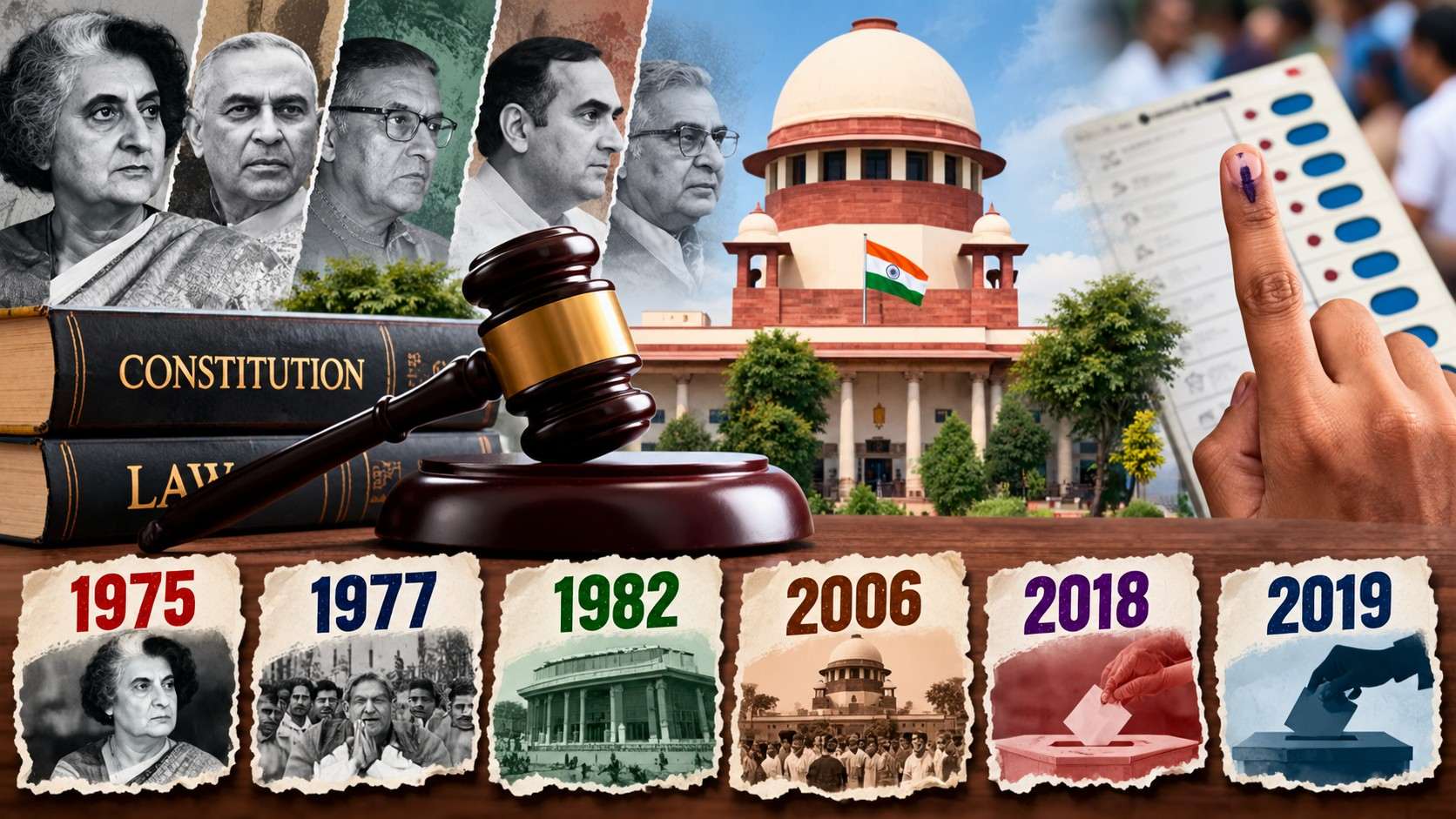
Earlier instances of election victories being set aside or stayed
Several election disputes over the years have resulted in court orders cancelling victories, directing re-polls or temporarily suspending the effect of a judgment.
Indira Gandhi’s Raebareli election, 1975
Raj Narain challenged Indira Gandhi’s victory from Raebareli in the 1971 Lok Sabha elections, alleging misuse of government machinery and officials.
On June 2, 1975, the Allahabad High Court annulled her election and barred her from contesting elections for six years. A state of Emergency was declared in the country after the verdict.
KM Mani and CH Mohammed Koya, Kerala
The Kerala High Court set aside the elections of CH Mohammed Koya and KM Mani after allegations of communal campaigning during the 1977 Kerala Assembly elections. Both were ministers in AK Antony’s first government. The Supreme Court subsequently ruled in their favour.
N Sivan Pillai, Kerala Assembly election, 1982
Electronic voting machines were used for the first time at 50 polling stations in the North Paravur constituency during the 1982 Kerala Assembly elections. CPI candidate N Sivan Pillai won the contest by 123 votes.
His rival, AC Jose, challenged the result, arguing that there was no legal provision allowing the use of EVMs. In 1984, the Supreme Court ruled in Jose’s favour, cancelled Pillai’s election and ordered a fresh poll using ballot papers at the 50 stations. Jose won the re-poll.
MJ Jacob, Kerala Assembly election, 2006
The Kerala High Court set aside the election of LDF candidate MJ Jacob from the Piravom constituency in the 2006 Kerala Assembly elections. The case involved allegations of corrupt practices, including the distribution of pamphlets that sought to damage the reputation of his rival, UDF leader TM Jacob.
The Supreme Court later stayed the High Court’s order.
KM Shaji, Kerala Assembly election, 2016
In November 2018, the Kerala High Court annulled the election of IUML and UDF MLA KM Shaji from Azhikode. Shaji had won the seat in the 2016 Kerala Assembly elections, and the case was filed by his rival, MV Nikesh Kumar of the LDF.
The court also imposed a six-year disqualification after finding him guilty under Section 123(3) of the Representation of the People Act, 1951. The case concerned campaign pamphlets that appealed to voters to support only a Muslim candidate and the alleged improper use of religious sentiments, which amounted to a corrupt practice.
Shaji moved the Supreme Court immediately. The apex court granted an interim stay on his disqualification and allowed him to continue as an MLA, but without voting rights or daily allowances.
OP Ravindranath Kumar, 2019 Lok Sabha election
In July 2023, the Madras High Court declared null and void the 2019 Lok Sabha election victory of OP Ravindranath Kumar from Tamil Nadu’s Theni constituency. He was the lone AIADMK MP from the state and the son of former Chief Minister O Panneerselvam.
A voter from the constituency had alleged that Ravindranath concealed details of his assets and income in his nomination papers and attempted to bribe or influence voters during the campaign. The Madras High Court held that the alleged actions were improper under the Representation of the People Act, 1951.
The Supreme Court has since stayed the High Court’s decision.